Overview
Labour force data are based on the mid-year Comprehensive Labour Force Surveys conducted by the Ministry of Manpower (MOM) every year.
Statistics on employment and wages are compiled by MOM. Statistics on labour productivity are compiled by the Singapore Department of Statistics.
Statistics on Central Provident Fund (CPF) members are compiled by the CPF Board.
Other subjects in this theme
Our Data Explained
Labour force data are based on the mid-year Comprehensive Labour Force Surveys conducted by the Ministry of Manpower (MOM) every year. The data refers to persons aged fifteen years and over. The reference period refers to the week preceding the date of the interview.
For more information on concepts regarding manpower indicators, please refer to the Concepts section on https://stats.mom.gov.sg/.
EDB's employment data are compiled from their Annual Census of Manufacturing survey (CMA). The CMA gathers data on the entire industrial sector with establishments engaging in activities of manufacturing and industrial servicing. These activities are classified in Section C of the Singapore Standard Industrial Classification (SSIC) 2020 edition. EDB's data are survey based and based on a representative sample of manufacturing establishments, i.e., not all manufacturing firms in Singapore are covered. Firms with more than 20 workers are surveyed with certainty while firms with lesser than 20 workers are sampled. More information on CMA are available at Report Census of Manufacturing Activities.
For policy decision making purposes, it is more appropriate to use employment data from administrative sources i.e., MOM, as they are the official source for manpower statistics. For clarifications on the CMA results, you may contact EDB at rsu@edb.gov.sg.
MOM’s data on number of workers employed in the manufacturing sector are compiled primarily from administrative records, with the self-employed component estimated from the Labour Force Survey. The employment data are as of year-end, i.e. end-December of each year. More information on the source and coverage are available on MOM’s Website. For clarifications, you can contact MOM at mom_rsd@mom.gov.sg.
The Singapore Workforce Skills Qualifications (WSQ) is a national credential system that trains, develops, assesses and certifies skills and competencies for the workforce. The WSQ programmes are funded and quality-assured by SkillsFuture Singapore, which awards the WSQ certifications.
Singapore citizens and permanent residents can access career matching services by Workforce Singapore (WSG) and National Trades Union Congress (NTUC)’s Employment and Employability Institute (e2i) via their physical career centres and digital platforms platforms at https://www.wsg.gov.sg/home, https://www.mycareersfuture.gov.sg/ and https://www.e2i.com.sg/individuals/ respectively.
These are the key providers of employment assistance services, which are compiled by WSG and reflect the number of job seekers assisted and successfully placed into employment.
Multifactor productivity (MFP) relates output to a set of combined inputs, usually labour and capital. A change in MFP reflects the change in output that cannot be accounted for by the change in combined inputs. MFP therefore measures the effects of changes such as technological progress and changes in the organisation of production.
The Central Provident Fund (CPF) is a key pillar of Singapore's social security system. It enables Singapore Citizens and Permanent Residents to set aside funds to build a strong foundation for retirement and also addresses members’ housing and healthcare needs.
For more information, please refer to the corrections and clarifications in Factually.
For more information, please refer to the corrections and clarifications in Factually.
For more information, please refer to the corrections and clarifications in Factually.
Glossary
Disabilities refer to the five main disability types as outlined in Singapore’s Enabling Masterplans: physical disability, visual impairment, hearing loss, intellectual disability, and autism.
Employment
Data on the number of persons in employment are primarily from administrative records, with the self-employed component estimated from the Labour Force Survey. While headline employment statistics on the number of persons employed and its quarterly changes by industry are primarily from administrative records, data on the demographic, social and other economic characteristics of employed persons such as age, sex, educational attainment and occupation are compiled annually from the Comprehensive Labour Force Survey.
Employment Change
Refers to the change in the number of persons who are in employment, derived by taking the difference in the employment level (i.e. number of employed persons) at the end of the reference period compared with the end of the preceding period. A positive change refers to the additional number of persons who are in employment, while a negative change refers to the decline in number of persons in employment.
Employment Level
Refers to the number of persons in employment, comprising employees and the self-employed.
Employed Persons
Refer to persons who, during the reference period:
- work for one hour or more either for pay or profit; or
- have a job or business to return to but are temporarily absent because of illness, injury, breakdown of machinery at workplace, labour-management dispute or other reasons.
Members of the Singapore Armed Forces including full-time National Servicemen are included in the persons employed, unless otherwise specified.
Employed Residents
Refer to residents (i.e., Singapore citizens and permanent residents) who, during the reference period:
- work for one hour or more either for pay or profit; or
- have a job or business to return to but are temporarily absent because of illness, injury, breakdown of machinery at workplace, labour management dispute or other reasons.
Members of the Singapore Armed Forces including full-time National Servicemen are included in the persons employed, unless otherwise specified.
Job Vacancy
Refers to the number of unfilled posts which an establishment is actively recruiting employees from outside the establishment. They exclude:
- Positions for which the employees have been appointed but not yet commenced duty;
- Positions open only to internal transfers or promotions.
Recruitment action to fill a post includes advertising in newspapers, posting notices on the internet (e.g. on online job banks), making word-of-mouth announcements, soliciting employees through employment agencies or job fairs, contacting or interviewing job applicants.
Long-Term Unemployment Rate
Defined as the percentage of unemployed persons who have been unemployed for 25 weeks or more to the labour force, i.e., proportion of unemployed persons who have been unemployed for 25 weeks or more out of all persons working or seeking work.
Occupation
Occupation of a working person refers to the kind of work the person was doing during the reference period, which may not necessarily be related to his training, skill or professional qualification. In the case of a person who performs two or more kinds of work, his occupation would refer to the one in which he usually works the longest hours during the reference period. The Singapore Standard Occupational Classification (SSOC) is used to classify working persons by occupation.
Total Employment
Total employment data are compiled primarily from administrative records, with the self-employed component estimated from the Labour Force Survey. Employment data from administrative records comprise all persons in employment. However, it excludes men who are serving their 2-year full-time national service in the Singapore Armed Forces, Police and Civil Defence Forces.
Unemployed Persons
Refers to persons aged fifteen years and over who are not working but are actively looking for a job and available for work during the reference period. They include persons who are not working but are taking steps to start their own business or taking up a new job after the reference period.
Unemployment Rate
Refers to the percentage of unemployed persons to the labour force.
Refers to the number of unfilled posts which an establishment is actively recruiting employees from outside the establishment. They exclude:
- Positions for which the employees have been appointed but not yet commenced duty;
- Positions open only to internal transfers or promotions.
Recruitment action to fill a post includes advertising in newspapers, posting notices on the internet (e.g., on online job banks), making word-of-mouth announcements, soliciting employees through employment agencies or job fairs, contacting or interviewing job applicants.
Labour Force Participation Rate
Refers to the percentage of the labour force to the population.
Persons in The Labour Force
Refer to persons aged fifteen years and over who are either employed (i.e., working) or unemployed (i.e., actively looking for a job and available for work) during the reference period.
Persons Outside the Labour Force
Refer to persons aged fifteen years and over who are neither employed nor unemployed during the reference period.
Collective Agreement
Refers to an agreement between employers and employees on industrial matters. The duration of a collective agreement is specified and by law shall not be less than two years or more than three years.
Industrial Arbitration Court (IAC) Award
Refers to an award made by the IAC, and includes a collective agreement and a memorandum of the terms which have been certified by the President of the IAC in accordance with the provisions of the Industrial Relations Act.
Trade Dispute
A dispute (including a threatened, impending or probable dispute) on industrial matters.
Trade Union
Refers to any association or combination of employees or employers, whether temporary or permanent, whose principal object is to regulate relations between employees and employers for all or any of the following purposes:
- to promote good industrial relations between employers and employees;
- to improve the working conditions of employees or enhance their economic and social status; and
- to raise productivity for the benefit of employees, employers and the economy of Singapore
Labour Productivity
Measures how much output is produced relative to the inputs of labour, capital (plant and equipment) and technology. An increase in productivity implies that more output can be produced with the same or less inputs.
Labour Productivity measures output per unit of labour input. VA is generally used as the measure of output, while labour input may be measured by number of employed persons or hours worked per employee.
Multifactor Productivity
Multifactor productivity (MFP) relates output to a set of combined inputs, usually labour and capital. A change in MFP reflects the change in output that cannot be accounted for by the change in combined inputs. MFP therefore measures the effects of changes such as technological progress and changes in the organisation of production.
Value Added
Gross value added is derived by the output or income approach.
The output approach measures value added as output less intermediate consumption. Output refers to the value of goods and services produced while intermediate consumption is value of goods and services consumed as inputs by a process of production, e.g., materials, utilities, fuel, rental paid for premises and equipment, banking and financial charges and other operating costs.
The income approach derives value added as the sum of incomes generated from the domestic production of goods and services, which comprise gross operating surplus, remuneration and taxes (less subsidies) on production
Average Monthly Recruitment Rate
Average monthly recruitment rate during a quarter is defined as the average number of persons recruited in a month during the quarter divided by the average number of employees in the establishment. The annual figures are the simple averages of the quarterly figures.
Average Monthly Resignation Rate
Average monthly resignation rate during a quarter is defined as the average number of persons who resigned in a month during the quarter divided by the average number of employees in the establishment. The annual figures are the simple averages of the quarterly figures.
Refers to the termination of permanent employees due to redundancy and early termination of term contract employees due to redundancy.
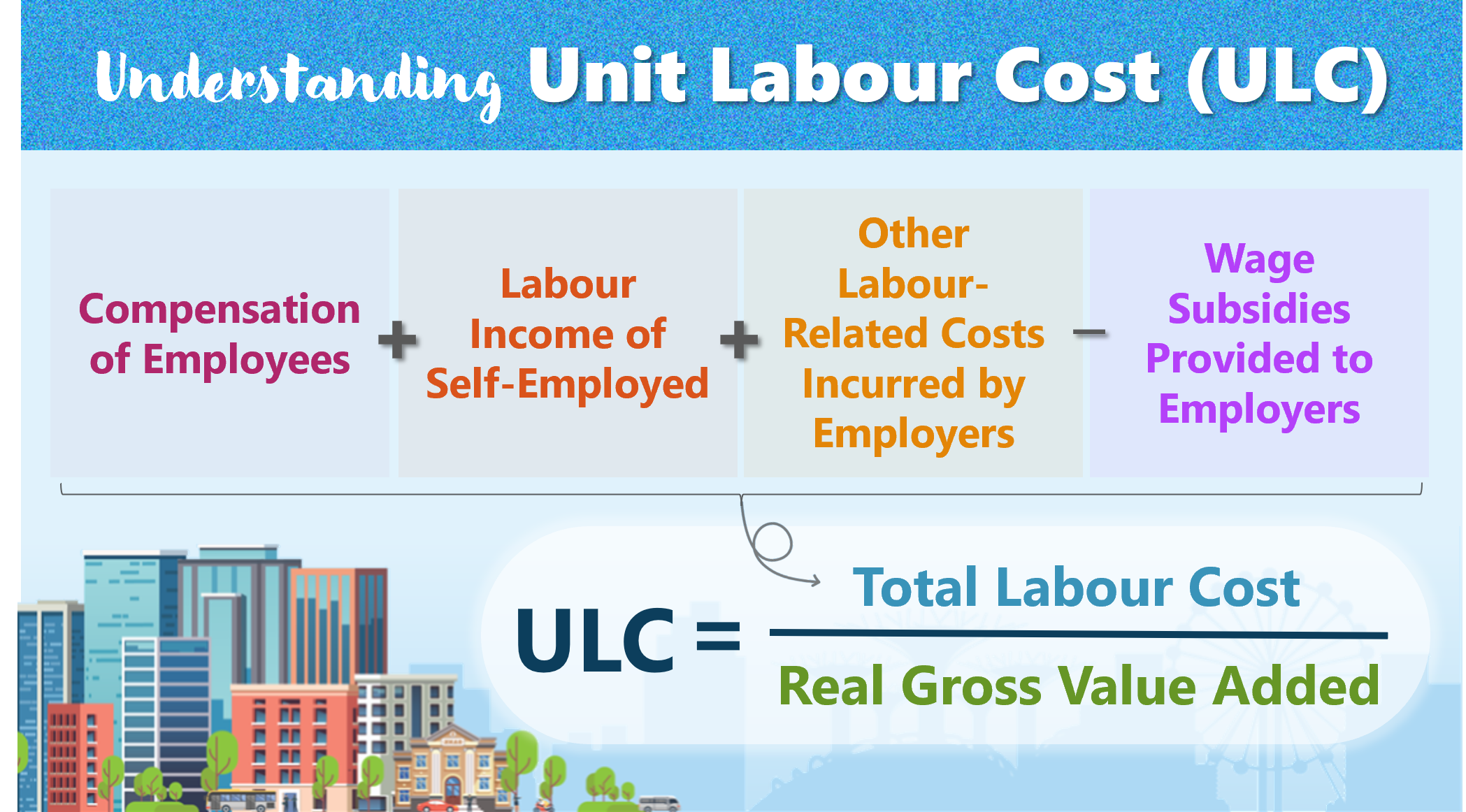
The average cost of labour per unit of output. It is computed as Total Labour Cost (TLC) per unit of real Gross Value Added (GVA).
TLC consists of:
- Compensation of Employees (CoE)
- Labour income of self-employed
- Other labour-related costs (e.g., Foreign Workers' Levy and net training costs) incurred by employers
- Wage subsidies (e.g., Wage Credit Scheme and Jobs Credit Scheme) that are provided to employers. Wage subsidies reduce employers' labour cost and are netted off from TLC.
Gross Monthly Income from Employment
Refers to income earned from employment. For employees, it refers to the gross monthly wages or salaries before deduction of employee CPF contributions and personal income tax. It comprises basic wages, overtime pay, commissions, tips, other allowances and one-twelfth of annual bonuses. For self-employed persons, gross monthly income refers to the average monthly profits from their business, trade or profession (i.e., total receipts less business expenses incurred) before deduction of income tax.
Paid Hours Worked
Refers to the total number of paid hours worked during a week by an employee. It is the sum of standard hours worked and paid overtime hours worked.
Workplace Fatal Injuries
Refer to workplace fatality rate (including work-related traffic injuries) of employees and self-employed persons.
Workplace Non-Fatal Injuries
Refer to the non-fatal workplace injury rate of employees with four or more days of medical leave, or at least 24 hours of hospitalisation.
Workplace Non-Fatal Injuries [N]
Refer to all non-fatal workplace injury rate of employees with any instance of medical leave or light duties.