
Statistics on national accounts provide up-to-date performance indicators for the Singapore economy.
Singapore adopts the output, expenditure, and income approaches for compiling national income aggregates. The concepts, definitions and methodologies given in the United Nations’ publication “System of National Accounts, 2008” (SNA) are closely followed. Singapore is currently reviewing the adoption of the updated 2025 SNA.
A significant improvement in the latest benchmarking of Singapore’s national accounts from reference year 2010 to 2015 is the adoption of the SNA recommendation to compile annually reweighted chain volume measures (CVM) of GDP.
Other subjects in this theme
Our Data Explained
GDP measures the market value of the goods and services produced in an economy. In line with international statistical standards outlined in the System of National Accounts, GDP does not include unpaid work such as volunteer work. Economies, including Singapore, follow these standards when computing GDP to ensure the international comparability of estimates.
Nonetheless, the value of volunteer work may be monitored through indicators beyond GDP, such as volunteering rates, hours volunteered, which are published by the National Volunteer & Philanthropy Centre.
Quarterly GDP estimates of year T are initially compiled using a wide range of timely short-term indicators of economic activities in each industry. These estimates offer a snapshot of the current economic situation for macroeconomic policymakers & analysts and comes prior to the availability of comprehensive annual survey benchmarks. Sources of these indicators used include high frequency administrative data and short-term survey data obtained from a relatively small number of companies or establishments.
As more comprehensive data on the full quarter's performance become available, these are incorporated in subsequent updates, ensuring that the estimates reflect the most accurate and up to date picture of economic activity.
For more information on revisions to GDP estimates, please refer to the GDP Release Schedule and Revisions document.
A comprehensive review of the GDP estimates, initially compiled from timely short-term indicators, occurs in year T+1 during the annual Economic Survey (ESS) exercise, incorporating comprehensive annual survey benchmarks and up-to-date administrative data.
Survey benchmarks are a comprehensive set of data compiled from aggregated establishment survey returns, typically available with a time lag of one to two years. Consequently, larger revisions are generally observed for recent-period data. Revisions also occur as GDP estimates by the three approaches (i.e., production, expenditure & income) are rebalanced and reconciled based on the updated annual supply and use tables.
This is elaborated in the table below.
Table 1. GDP revision process across annual ESS publications
| Annual ESS Publication | Description |
| ESS Year (T) | The first-available annual GDP estimates (T) are compiled using a wide range of timely short-term indicators of economic activities in each industry. Sources of these indicators include administrative and short-term survey data. These timely estimates provide a snapshot of the current economic situation for macroeconomic policymakers & analysts. The compilation of statistics generally involves a trade-off between timeliness and accuracy. Revisions are expected as more comprehensive information becomes available over time. |
| ESS Year (T+1) | A comprehensive review of the GDP estimates occurs annually during which annual survey benchmarks and up-to-date administrative data are incorporated (T+1). Survey benchmarks are a comprehensive set of data compiled from aggregated survey returns from establishments. These benchmarks are typically only available 9 to 15 months after the reference period, as detailed survey results follow after companies have compiled full financial details from their operations and filed statement of accounts. |
| ESS Year (T+2) | In year T+2, the GDP estimates are further revised to incorporate updates to firms' survey returns. These updates could be due to late and/or revised returns from some firms. Additionally, GDP estimates compiled by the three approaches (i.e., production, expenditure & income) are also reconciled based on the annual supply & use tables (SUTs at T+2). This process balances the production and consumption of goods and services in the economy, aligning the GDP estimates from different approaches more closely. |
| ESS Year (T+3) and beyond | Fewer revisions are anticipated in subsequent ESS, unless significant changes occur in survey data, methodologies, or international frameworks. In particular, GDP estimates may be revised during periodic benchmarking exercises which reconcile the estimates of GDP by the three approaches (production, income and consumption) and provide the occasions for methodological and conceptual reviews and improvements. |
For more information on revisions to GDP estimates, please refer to DOS' publication on the Analysis of Revisions to GDP Estimates, available at Analysis of Revisions to Gross Domestic Product Estimates or refer to the GDP Release Schedule and Revisions document.
The Output-based GDP by industry and their corresponding sections in the SSIC 2020 can be found in the Output-based GDP (Industry Breakdown) document.
PCE refers to final purchases of goods and services by resident households including non-profit institutions serving households. It includes spending on items such as food, healthcare, education, transportation, and recreation.
In the national accounts, PCE is classified by key consumption purpose based on internationally aligned standards.
For more information, you may view the Understanding Private Consumption Expenditure (PCE) by Key Consumption Purpose Infographic.
To understand how PCE differs from Household Consumption Expenditure (HCE), check out the Understanding the Differences between Private Consumption Expenditure and Household Consumption Expenditure infographic.
Glossary
Basic Price
The amount receivable by the producer from the purchaser for a unit of a good or service produced as output minus any tax payable, and plus any subsidy receivable, on that unit as a consequence of its production or sale; it excludes any transport charges invoiced separately by the producer.
Collective Government Consumption Expenditure
Collective government consumption expenditure consists of expenditure on goods and services incurred by the government for the benefit of the community as a whole or large sections of the community (e.g., national security and defence).
Compensation of Employees (CoE)
Total remuneration, in cash or in kind, payable by enterprises to employees in return for work done. Examples include basic wage, bonuses, welfare benefits and employers' CPF contributions.
Consumption of Fixed Capital
The decline, during the course of the accounting period, in the current value of the stock of fixed assets owned and used by a producer as a result of physical deterioration, normal obsolescence or normal accidental damage.
Corporations Sector
Corporations sector comprises the non-financial corporations and financial corporations sectors.
Domestic Territory
In addition to the territory lying within the political frontiers of a country, domestic territory includes:
- ships and aircraft which are entirely or mainly operated by residents of the country;
- fishing vessels, oil and natural gas rigs, and floating platforms which are wholly or mainly operated by the residents of the country; and
- the embassies, consulates and military establishments of the country located abroad.
However, it excludes overseas territories and possessions.
Expenditure-based Gross Domestic Product (GDP)
The sum of private consumption expenditure, government consumption expenditure, gross capital formation and net exports of goods & services
External Demand
The exports of goods and services.
Final Domestic Demand
The sum of private consumption expenditure of households including non-profit institutions serving households, government consumption expenditure and gross fixed capital formation.
Fixed Assets
Produced assets (e.g., buildings and infrastructure, transport equipment, machinery and equipment, and intellectual property products) that are used repeatedly or continuously in production processes for more than one year.
Financial Intermediation Services Indirectly Measured (FISIM)
The value of financial services associated with loans and deposits provided by financial institutions (e.g., banks), of which no explicit commissions and fees are charged. FISIM arises from interest margins due to differences in interest rates applied to borrowers (loans) and lenders (deposits).
General Government
General government sector comprises government agencies and statutory boards providing goods and services either for free or at prices or fees that are economically insignificant (i.e., prices which do not have a significant influence on both the amounts producers are willing to supply and the amounts purchasers wish to buy).
Generation of Income Account
Generation of Income Account refers to the primary incomes [i.e., compensation of employees (CoE), gross operating surplus (GOS) and other taxes less subsidies on production (OTSP)] accruing to the institutional sectors.
Government Consumption Expenditure
Expenditures incurred by the general government on consumption goods and services provided to the general public.
Gross Capital Formation
Total value of gross fixed capital formation and changes in inventories.
Gross Domestic Product (GDP)
Aggregate value of the goods and services produced in the economic territory of Singapore. The GDP estimates are compiled based on the output (or production), expenditure and income approaches. See Output-based GDP, Expenditure-based GDP and Income-based GDP.
Gross Domestic Product (GDP) Deflators
A broad measure of the change in the overall level of prices of the goods and services that make up GDP. The deflators are derived as the ratio of the nominal value of a component of GDP to its corresponding real value, with the reference year index set at 100.
Gross Fixed Capital Formation
Acquisitions, less disposals, of fixed assets during the accounting period plus improvements to land.
Gross National Income (GNI)
The aggregate value of the gross balances of primary incomes (incomes arising from the involvement in production processes or ownership of assets) receivable by resident units.
Gross Operating Surplus (GOS)
The surplus accruing to owners from production before deducting property incomes payable on financial assets and other natural resources required to carry on the production. Estimates for Gross Operating Surplus are mainly derived as the value of output less intermediate consumption, Compensation of Employees and Other Taxes less Subsidies on Production. National accounts adjustments such as financial intermediation services implicitly measured (FISIM) and capitalisation of software as well as research & development (R&D) expenditure are incorporated.
Income Components of Gross Domestic Product (GDP)
The sum of incomes generated from the domestic production of goods and services. These include compensation of employees, gross operating surplus and taxes less subsidies on production and on imports.
Individual Government Consumption Expenditure
Individual government consumption expenditure consists of expenditure on goods and services incurred by the government on behalf of the households (e.g., public education and healthcare which are consumed by individuals or households).
Institutional Sectors
Corporations sector comprises the non-financial corporations and financial corporations sectors. Personal sector comprises the household sector and non-profit institutions serving households (NPISH) sector. General government sector refers to government agencies and statutory boards providing goods and services either for free or at prices or fees that are economically insignificant.
Intermediate Consumption
Intermediate consumption is the value of goods and services consumed as inputs by a process of production e.g., materials, utilities, fuel, rental paid for premises and equipment, banking and financial charges and other operating costs.
Inventories
The amount of materials and supplies, work-in-progress, finished goods and goods for resale.
Market Prices
The actual prices agreed upon by the parties in the transactions. In the absence of market transactions, valuation is made according to costs incurred or by reference to market prices for similar goods or services.
Net Capital Stock
Net capital stock is the value of all fixed assets still in use, measured at the current market price of new assets of the same type after deducting the accumulated depreciation (consumption of fixed capital) of these assets. It can also be derived by subtracting the accumulated depreciation from gross capital stock.
Net Exports of Goods and Services
Value of total exports of goods and services less total imports of goods and services.
Net Operating Surplus
Obtained by deducting remuneration, depreciation of fixed assets and indirect taxes from value-added.
Net Value of Fixed Assets
Refers to the gross value net of accumulated depreciation.
Net Income from Abroad
Primary income received by residents of a country from abroad less primary income paid abroad to non-residents.
Net National Income
Gross national income less consumption of fixed capital.
Nominal Estimates
Estimates which are valued based on prices of the current reporting period. For example, nominal estimates for year 2023 are valued at 2023 prices.
Other Taxes Less Subsidies On Production
Consists of production taxes or subsidies. Production taxes are payable by enterprises during the process of production. Examples include foreign worker levy and property tax. Production subsidies are receivables by enterprises during the process of production. Examples include job credit pay-outs and government-paid maternity leave.
Output
Output refers to the value of goods and services produced in the economy.
Output-based Gross Domestic Product (GDP)
The sum of gross value added generated by economic activities in the domestic economy.
Ownership of Dwellings
Housing services provided by owner-occupiers and individuals who let out their residential properties.
Per capita GDP
Per capita GDP is derived by dividing total gross domestic product by total population.
Per capita GNI
Per capita GNI is derived by dividing total gross national income at current prices by total population.
Personal Sector
Personal sector comprises the household sector (including ownership of dwellings, sole proprietors & partnerships and own-account workers) and non-profit institutions serving households (NPISH) sector.
Primary Input Requirement Coefficients of Final Demand
Primary Input Requirement Coefficients of Final Demand show the primary input content of final demand. Primary inputs include imports, taxes on products and production, compensation of employees and gross operating surplus.
Private Consumption Expenditure
The final purchases of goods and services by resident households including non-profit institutions serving households.
Producer's Price
The amount receivable by the producer from the purchaser for a unit of a good or service produced as output minus any VAT, or similar deductible tax, invoiced to the purchaser. It excludes any transport charges invoiced separately by the producer.
Production Account
Production Account refers to the output, intermediate consumption (IC) and gross value added (GVA) of the economy by institutional sector.
Purchaser's Price
The amount paid by the purchaser, excluding any deductible VAT or similar deductible tax, in order to take delivery of a unit of a good or service at the time and place required by the purchaser. The purchaser's price of a good includes any transport charges paid separately by the purchaser to take delivery at the required time and place.
Real Estimates
Real estimates exclude the effects of price changes from period to period. For example, real GDP refers to GDP adjusted for price changes.
Real Gross Domestic Product (GDP)
GDP adjusted for price changes to reflect the real value of output or expenditure over time. Real GDP is compiled in chained (2015) dollars.
Remuneration
The total remuneration of employees. Remuneration comprises three components, namely:
- Wages and salaries
- Employers' contribution to Central Provident Fund (CPF) or pension funds
- Other benefits
It does not include the remuneration of working proprietors and partners.
Residence
A concept used for the compilation of the national accounts and balance of payments estimates. Residents of a country include individuals residing in the country, corporations and enterprises located in the country as well as its embassies, military units, and official missions stationed abroad.
Seasonally Adjusted
Seasonal adjustment is the process of estimating and removing the seasonal and calendar effects from a time series so as to show its underlying trend and short-term movements clearly. The seasonally adjusted time series facilitates a better assessment of their recent movements.
Statistical Discrepancy in Gross Domestic Product (GDP)
The measurement of the three approaches of GDP (production, income and expenditure) should conceptually be the same. In practice, however, they can be different as they are compiled largely from independent and diverse surveys and administrative sources. In Singapore, output-based GDP (i.e., GDP by production) is the main approach used, and statistical discrepancies are recorded at the income and expenditure approaches.
Taxes less Subsidies on Production and on Imports
Comprises taxes on products and other taxes less subsidies on production.
Taxes on products are taxes payable per unit of goods and services when they are produced, delivered, sold, transferred or disposed of by their producers. Examples include goods and services tax (GST), stamp duties and Certificate of Entitlement of motor vehicles.
Other taxes less subsidies on production consist of production taxes or subsidies. Production taxes are payable by enterprises during the process of production. Examples include foreign worker levy and property tax. Production subsidies are receivable by enterprises during the process of production. Examples include jobs credit pay-outs and government-paid maternity leave.
Taxes on Products
Refers to taxes payable per unit of good and services when they are produced, delivered, sold, transferred or otherwise disposed of by their producers.
Total Demand
The sum of total domestic demand and external demand. Contribution to total demand of a segment is derived by taking total demand as the base.
Total Domestic Demand
The sum of private consumption expenditure of households including non-profit institutions serving households, government consumption expenditure and gross capital formation.
Value Added
Gross value added is derived by the output or income approach.
The output approach measures value added as output less intermediate consumption. Output refers to the value of goods and services produced in the economy while intermediate consumption is value of goods and services consumed as inputs by a process of production, e.g., materials, utilities, fuel, rental paid for premises and equipment, banking and financial charges and other operating costs.
The income approach derives value added as the sum of incomes generated from the domestic production of goods and services, which comprise gross operating surplus, remuneration and taxes (less subsidies) on production.

How does Trade Contribute to Output-based GDP?
Graphical overview of how trade, i.e., exports and imports, contributes to output-based GDP.
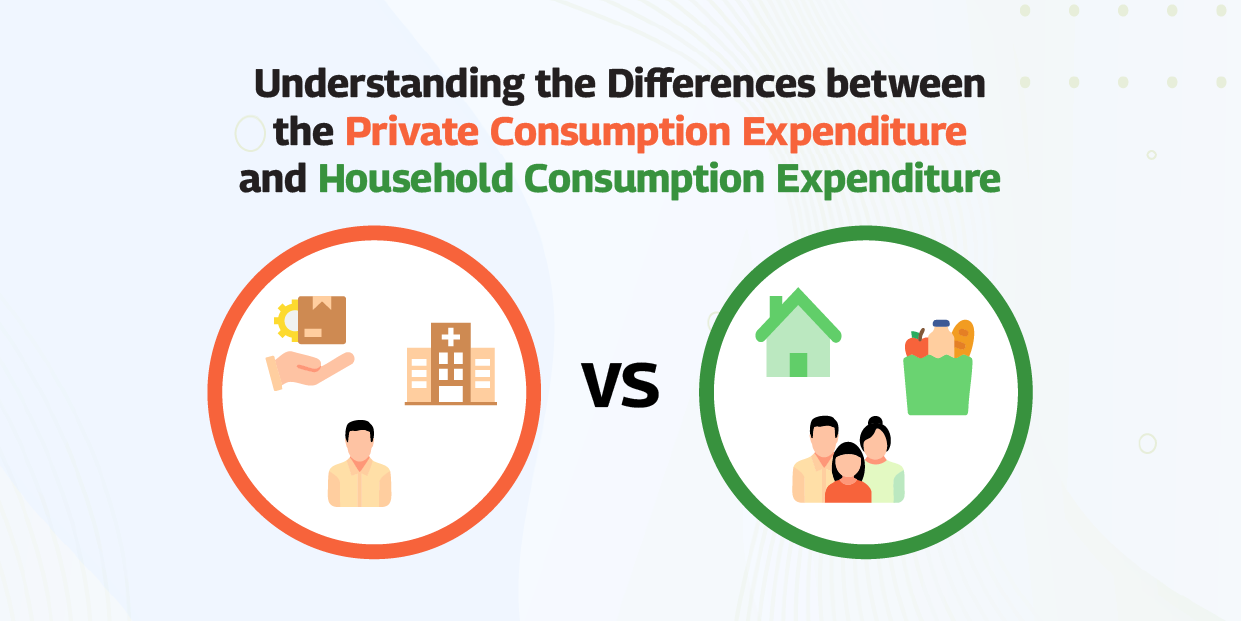
Understanding the Differences between the Private Consumption Expenditure and Household Consumption Expenditure
A graphical guide on the key distinctions between the Private Consumption Expenditure and Household Consumption Expenditure, covering purpose and methodology.

Wholesale Trade: A Sectoral Analysis
A visual guide offering key insights into Singapore's Wholesale Trade Industry and its six distinct segments.

How do Concerts Held in Singapore Benefit the Economy?
This infographic explains the impact of concerts on Singapore's economy.
Understanding Private Consumption Expenditure by Key Consumption Purpose
A graphical guide to the concepts and key highlights of private consumption expenditure.

Singapore’s Gross Domestic Product: Did You Know
Explore Singapore's Gross Domestic Product, including the contribution of key goods producing and services producing industries to the Singapore economy.
A Closer Look: Diversification of Singapore’s Economy
This video explains how a well-diversified Singapore economy has helped us grow and remain resilient.
Introduction to Chain-Linking of Real Gross Domestic Product
This video explains the concept of chain-linked real GDP.
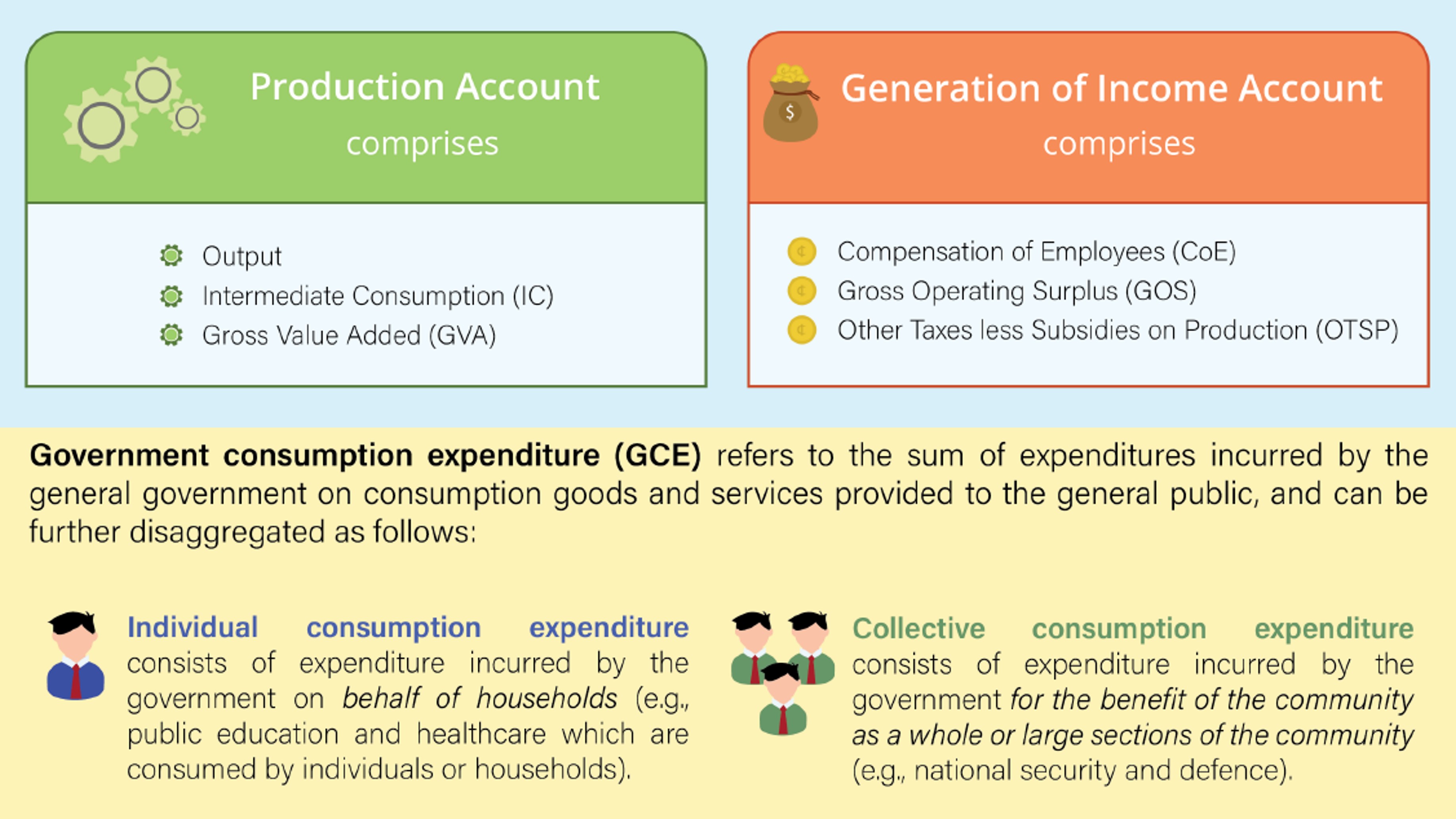
Production and Generation of Income Accounts & Government Consumption Expenditure by Individual and Collective Consumption
A graphical guide to production and generation of income accounts by institutional sector, and government consumption expenditure by individual and collective consumption.