Overview
Learn about the common types of data, chart types typically used for data visualisation, and real-world applications of mathematical concepts such as seasonal adjustment.
How to Analyse Data
Unit of Analysis: Who's in the Spotlight?
The unit of analysis refers to the entity that is being studied in a dataset. For example, in clinical trials, the unit of analysis could be an individual (i.e., the patient). Macroeconomic studies may consider a whole country as a unit of analysis, e.g., comparing the productivity of workers between countries.
Units of analysis commonly found in the data published by DOS includes:
- Individuals, on Population Structure (by Residency, Age, etc.), Marital Status, etc.
- Households, on Household Expenditure, Household Income from Work, etc.
- Firms, on Productivity, Value-added, Business Receipts Index, Retail Sales Index etc.
Types of Data: Which One Tells Your Story?
Quantitative Data versus Qualitative Data
Qualitative data are generally non-numerical which relate to words, pictures or even videos. It helps to answer ‘what’ or ‘why’ questions. An example is sentiments data which describe how individuals are feeling. Qualitative data can be analysed by grouping the data into themes or categories.
Quantitative data are numerical in nature, and help to answer questions pertaining to ‘how much’ or ‘how many’ etc. Quantitative data can be analysed using statistical analysis. Examples of quantitative data are as follows:
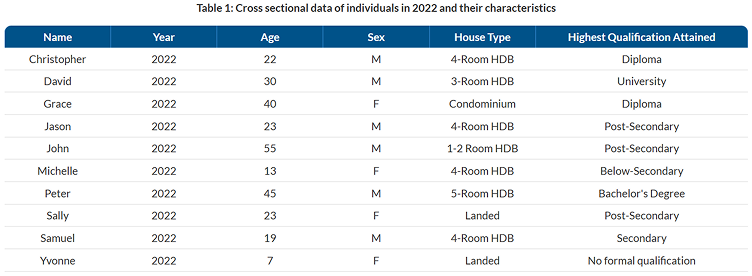
- Data are collected over a single time period (e.g., records are from a specific year).
- Allows the comparison of characteristics between units or groups at a fixed point in time.
From the table below, it can be seen that in 2022, there were 6 males and 4 females. Of the 4 females, only 1 lives in HDB housing while the rest live in private estates.
Primary Data vs. Secondary Data
Primary data refer to data directly collected from the data source. This can be through surveys, interviews, or experiments. Primary data are generally considered reliable and objective. However, due to limitations such as cost and complexity of data, collecting primary data may not always be possible.
Secondary data refer to data collected by another party. One drawback is that secondary data are often not tailored to accommodate the specific needs of the researcher. It may also be costly to purchase if it is not freely available to the public.
How to Analyse the Data: A Chart is Worth a Thousand Words!
Graphs and charts help to present complex data in a visually appealing and simple-to-understand manner.
Learn about the common types of graphs and charts below.