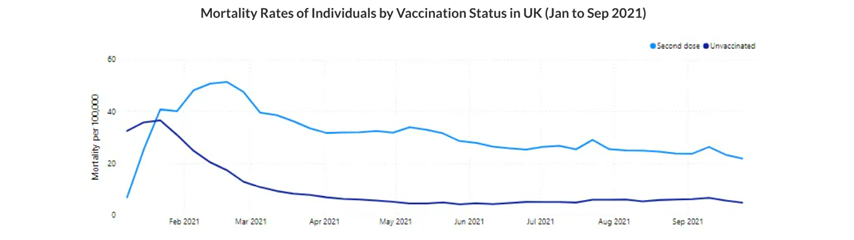
Statistics from Office for National Statistics of United Kingdom (ONS) showed that death rates for the vaccinated were greater than the unvaccinated. These numbers could be wrongly used to argue that vaccination increases the risk of death.
Simpson’s Paradox refers to the observation of a trend that is present when data are aggregated, but disappears or reverses when the groupings are made clearer (e.g., grouping by age or vaccination status). The paradox arises because death rates increase significantly with age, such that mortality rates are higher for older folks as compared to younger folks, other things being equal. Older people are more likely to be vaccinated as compared to younger people in the same age range, and are also more likely to die from Covid-19 infection or other health reasons. Therefore, age is a confounding variable since it is positively related to both vaccination rates and death rates. It is age, rather than vaccinations that is driving up the death rates of vaccinated people.
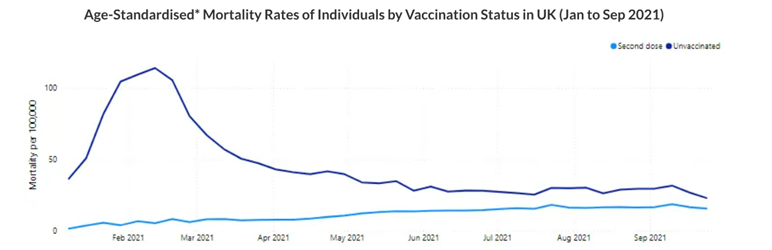
The mortality rates shown in the line chart below is a crude measure of mortality, and do not take into account the age structure of the population. Accounting for the age structure of the population is important since it can influence the number of deaths. For example, the younger population will likely have fewer deaths than the older population, all else being equal.
Instead, age-standardised mortality rates^ can be used to meaningfully compare between populations with different age structures. Age-standardised mortality rates can be computed by first calculating the mortality rates within each specified age band, followed by taking the weighted average based on a standardised age distribution.
Suppose there are 2 countries – City A and City B. City A has a younger population compared to City B but has higher mortality rate for all age bands. For simplicity, assume that there are 3 age bands – young, middle, old.
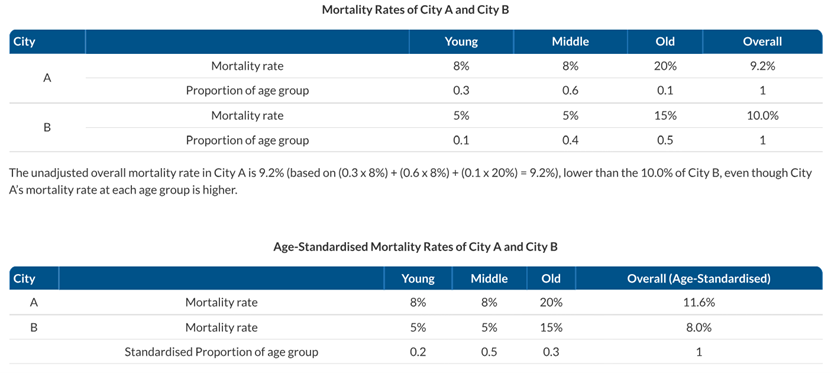
To do age adjustments, take the weighted average of each countries’ mortality rate using a standardised set of age group proportions in table above. In this case, the mortality rate of City A becomes 11.6% (=(0.2 x 8%) + (0.5 x 8%) + (0.3 x 20%)), and this is higher than City B’s 8.0%.
Going back to the COVID-19 vaccination example from ONS, looking at the age-standardised death rates, the death rates of vaccinated are lower than those of the unvaccinated.
^For more information on age-standardised mortality rates for Singapore, please refer to the Statistics Singapore Newsletter article.
*Age-standardised mortality rates per 100,000 people, standardised to the 2013 European Standard Population using 5-year age groups from age 10 and over.
The above information are cited from Office for National Statistics of United Kingdom (ONS) and the usage of the information is subjected to ONS's terms and conditions.