
This section includes short-term performance indicators that offer quick insights into the services industries:
- Monthly retail sales and food & beverage services indices,
- Quarterly wholesale trade series,
- Quarterly business receipts for services industries
It also features comprehensive annual data offering in-depth insights into the services industries.
Other subjects in this theme
Our Data Explained
The Data for Businesses webpage contains BITE - Business Insights Tool for Enterprises to empower businesses to make data-driven decisions with insights on customers, industry and business performance.
You may refer to the following documents for more information on the statistics of the Services industries in Singapore:
- Annual statistics of the Services industries in Singapore: Annual Services Statistics – All Services Industries (Technical Notes)
- Monthly and quarterly statistics of the Services industries in Singapore: Press Releases
Retail trade refers to the sale of goods by retailers directly to the general public for personal or household consumption. In contrast, wholesalers do not sell goods directly to the general public for personal or household consumption. Wholesalers acquire goods from producers or other suppliers, which are then sold to other buyers, e.g., retailers, other wholesalers, manufacturers etc.
Glossary
Business Receipts
Business receipts refer to the income earned by firms from their business activities.
For most industries covered in the new QBRS series, this comprises operating revenue from services rendered and sales of goods, including items such as professional and consultancy fees, management and administrative fees, commissions, rental and lease income, royalties and licence fees, and repair and servicing charges. Non-operating revenue such as interest income, investment earnings and government grants are excluded.
For Wholesale & Retail Trade and Food & Beverage Services, business receipts are measured using sales, as these represent the core business activity of these industries and constitute the predominant component of their operating revenue. For Wholesale Trade specifically, this covers domestic wholesale sales within Singapore and foreign wholesale sales outside Singapore. The latter includes sales of offshore merchandise, domestic exports, re-exports and transhipment cargo.
For Retail Trade and Food & Beverage Services, business receipts refer to the value of retail goods or food and beverages sold to consumers during the period, excluding taxes on products such as Goods and Services Tax (GST), Additional Registration Fee (ARF) and Certificates of Entitlement (COE).
Depreciation
Refers to the decline in value of physical assets (such as buildings, plant and machinery) over time, measured at current replacement cost. This decline occurs due to normal wear and tear from use, technological obsolescence, and typical accidental damage. Depreciation represents the portion of an asset's value that is consumed during a specific accounting period.
E-commerce Revenue
Refers to the revenue earned from the sale of goods and services whereby the company remotely receives orders or agrees on the price and terms of sale via online means. This includes transactions through the company's website, third-party websites (e.g., online marketplaces, food delivery platforms), mobile applications, extranet or Electronic Data Interchange (e.g., GeBIZ, the Singapore Government’s one-stop e-procurement portal), regardless of how or where the goods and services are delivered or collected. This excludes orders made via telephone calls, facsimile, in-premise orders via kiosks or QR codes, and manually entered emails or messages. Payment may or may not be made online.
Enterprise
Refers to an incorporated or registered entity (such as company, sole-proprietorship, partnership, association or society, etc).
Establishment
An establishment refers to a business or organisational unit that is engaged in one primary economic activity at a single physical location.
Multiple activities at one location: When an organisation operates different economic activities at the same physical address (such as a hotel with a restaurant, retail shop, and conference facilities), each distinct activity is treated as a separate establishment for statistical purposes.
Multiple locations with same activity: When an organisation operates the same type of business at different physical addresses (such as a retail chain with stores in various locations), each location is counted as a separate establishment, even if they share the same ownership, management, or brand name.
Gross Operating Surplus
The surplus accruing to owners from production before deducting any explicit or implicit interest charges, rent or other property incomes payable on the financial assets, land and other natural resources required to carry on the production. Estimates for GOS is mainly derived as the value of firms' operating receipts less their operating expenditure, plus depreciation of their fixed assets.
Operating Expenditure
Refers to costs incurred in an entity's day-to-day operations, adjusted for changes in inventory. These expenses are fully recognised in the current accounting period and include remuneration, purchases of goods and materials, work contracted out, rental and maintenance of premises, machinery and equipment, professional services, utilities, transport, advertising, depreciation, indirect taxes, and other expenses directly related to the entity's operations. This excludes capital expenditure, loan principal repayments, and interest expenses.
Operating Revenue
Refers to income generated from an entity's operational activities, including both primary and secondary activities. This generally excludes investment income, gains (net of losses) from asset sales, or other non-operating sources, though specific inclusions may vary by industry.
For Services industry: This includes income from services rendered, sale of goods, commission fees, and rental of premises, machinery and equipment.
For Utilities industry: This includes income from supply or resale of utilities (such as electricity, gas, and water), resale of other goods (such as recycled materials), and provision of environmental health services including waste treatment and disposal.
Operating Revenue Per Square Metre
Defined as operating revenue divided by total floor area (in square metres). Floor area includes selling space, office space and storage space at the premise, but excludes those rented out, open spaces, open car parks, staff accommodation and unoccupied premises. Space occupied by concessionaires is also included for department stores and supermarkets.
Remuneration
Comprises all forms of compensation provided to employees and includes:
- Wages and salaries including commissions, bonuses and overtime pay before deduction of employee's contribution to CPF or any other deductions, as well as paid annual leave and paid sick leave.
- Employer's contribution to CPF and pension funds but excludes pension and gratuities paid to retired employees.
- Stock options and other share-based payments given to employees as part of their remuneration package.
- Staff benefits such as medical care, meals, housing, transport, and other benefits-in-kind provided to employees by the firm, but excludes retrenchment benefits, entertainment allowances, cost of staff uniforms, and travel, accommodation, and other daily allowances provided in connection with business travel (i.e., per diems).
Retail Sales Index (RSI) and Food & Beverage Services Index (FSI)
Retail Sales Index:
The Retail Sales Index (RSI) measures the short-term performance of the Retail Trade industry based on the sales records of Retail Trade establishments. The base year for the indices is 2025. The RSI is available at current prices and in chained volume terms. The indices at current prices measure the change in sales values, which can result from changes in both price and quantity, while the indices in chained volume terms measure the change in the volume of economic activity by removing the price effect.
Food & Beverage Services Index:
The Food & Beverage Services Index (FSI) measures the short-term performance of the Food & Beverage (F&B) services industry based on the sales records of F&B services establishments. Individual stalls in hawker centres, food courts, coffee shops or canteens are not covered. The base year for the indices is 2025. The FSI is available at current prices and in chained volume terms. The indices at current prices measure the change in sales values, which can result from changes in both price and quantity, while the indices in chained volume terms measure the change in the volume of economic activity by removing the price effect.
Value Added
Gross value added is derived by the output or income approach.
The output approach measures value added as output less intermediate consumption. Output refers to the value of goods and services produced while intermediate consumption is value of goods and services consumed as inputs by a process of production, e.g., materials, utilities, fuel, rental paid for premises and equipment, banking and financial charges and other operating costs.
The income approach derives value added as the sum of incomes generated from the domestic production of goods and services, which comprise gross operating surplus, remuneration and taxes (less subsidies) on production.
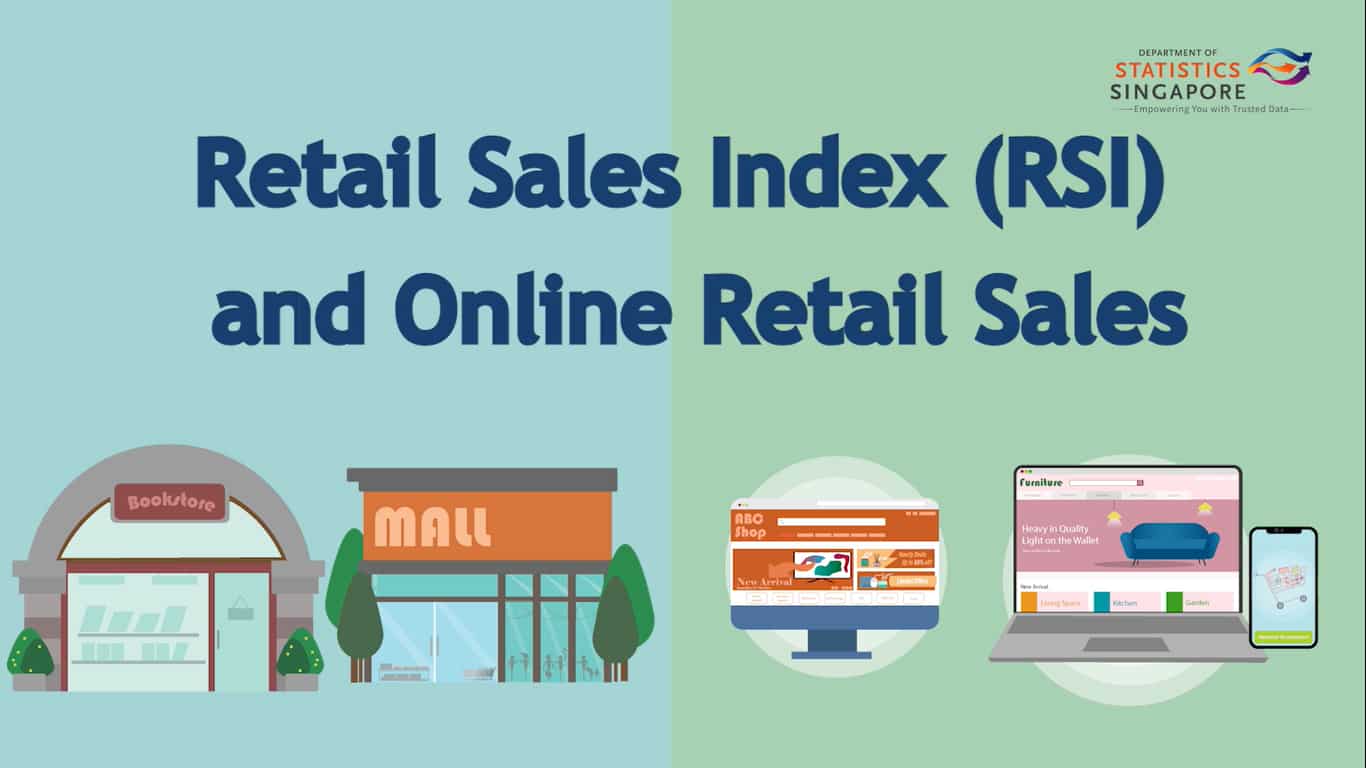
Retail Sales Index and Online Retail Sales
This video explains the Retail Sales Index (RSI) and the Online Retail Sales indicators that measure the performance of retail firms in Singapore.